


Our Legacy


Motorsport Heritage. Designed for Today.
Powell Livery draws on decades of experience gained within the design environments of Porsche and BMW, combining motorsport heritage, proportion and visual clarity to create authentic vehicle identities for road, track and competition use. Every project is guided by principles developed through endurance racing, advanced vehicle design and historic restoration: clarity, balance and purpose.
Porsche — The Foundation of Our DNA
Chief Designer Robert Powell, Dip. R.C.A., began his career at Porsche following graduation from the Royal College of Art in London. Based at the Weissach development centre for more than a decade, he worked alongside the designers and engineers responsible for some of Porsche's most significant road and racing cars.
His motorsport experience includes programmes such as the 936 "Essex", 956/962 "Rothmans", 962 "Shell", and the Paris-Dakar 911 and 959. Design projects ranged from the Group B concept that evolved into the Porsche 959 through to advanced concept studies, production development and industrial design programmes.
After twelve formative years at Porsche, Robert expanded his design activities internationally, first with BMW Technic, advanced concepts then the BMW production studios -bringing this experience to a wider range of automotive and motorsport projects.


BMW Technik / BMW Group — Advancing Future Design
The next twenty years were spent within the BMW Group. At BMW Technik — the company’s advanced research centre — Robert designed concept vehicles including Z13 and Just 4/2, led exterior development for future product direction, and oversaw the BMW–Williams Formula One livery programme — eventually becoming Head of Design.
After a decade at this innovative facility — even featuring its own wind tunnel for concept testing — he joined BMW Group Design, leading advanced show car and prototype development alongside design strategy work with marketing and engineering, before establishing and managing BMW Exterior Detail Design, responsible for lighting, wheels and engine bay executions.
Powell Livery Design
Today, Robert applies that same philosophy — where precision meets emotion — to bespoke livery design. Whether recreating a legendary racing scheme, restoring a classic, or crafting a distinctive modern identity, his focus remains on clarity, proportion, and authenticity. A legacy of design excellence, delivered to clients worldwide.
GET A FREE CONSULTATION ON YOUR PROJECT
Porsche Projects, Concept ideas and Recollections:
Porsche 936 ESSEX
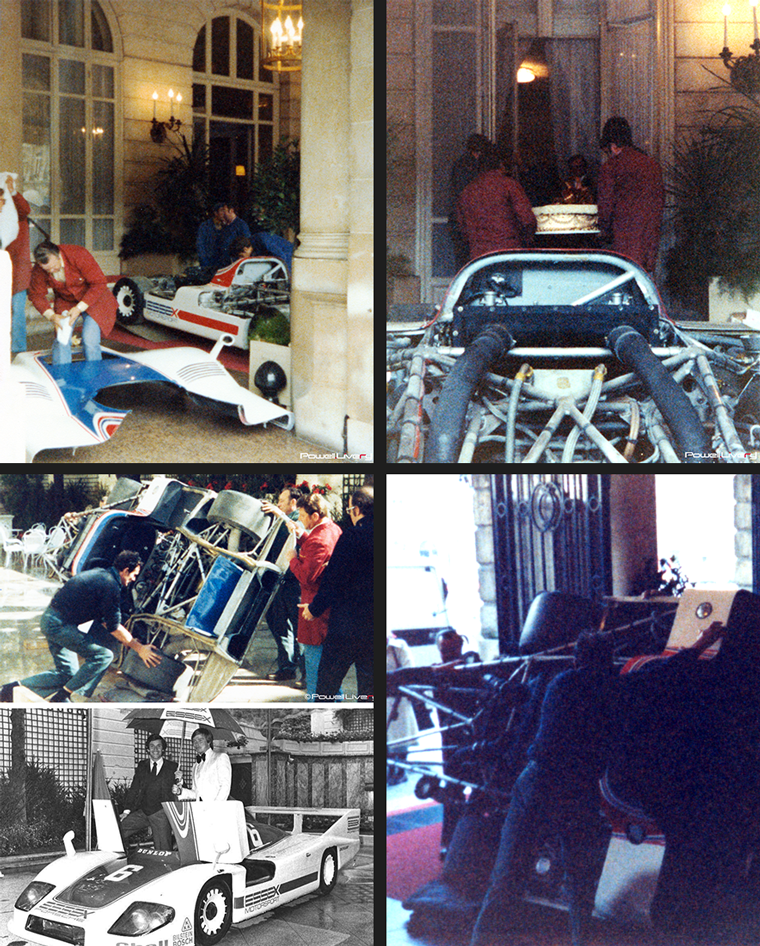
Fresh out of college, the Essex 936 became my very first Porsche livery. The presentation car was painted in Bad Kreuznach and then transported to Paris for its official unveiling—before we had even produced the decals. As a result, we flew to Paris for several days to finish the car on site and take part in the evening presentation.
Arriving at the Ritz, I was greeted by an unforgettable scene. The 936 stood outside the main entrance while Porsche mechanics debated how on earth they were going to get it through such a narrow doorway. The celebration cake only just made it inside—with some help from the mechanics—but the car was another matter entirely.
The late Mansour Ojjeh (TAG) had asked the hotel management if the 150-year-old entrance door could be removed. The response was a very polite but very firm French refusal: the door had been there for “a very long time…”.
A solution had to be found. Eventually, a team arrived, the bodywork was removed, and the car was carefully carried on its side through the lobby and into the garden courtyard at the rear of the Ritz.
During the day, we held a meeting in the Essex Suite to discuss ideas for the transport trucks. I had no drawing materials with me, so I was chauffeured through the back streets of Paris to an art shop to buy what I needed. Back at the Ritz—somehow surrounded by the girls preparing for that evening’s event—I sketched concepts for how the trucks might look. In the end, they were never painted.
The presentation took place later that evening, in the rain. It was a magnificent occasion where no expense was spared. To say that champagne and caviar flowed would be an understatement. Many of the great names from the motoring world were present, including leading drivers and the late Colin Chapman.
Porsche Club UK. ‘Art for Art’s Sake’
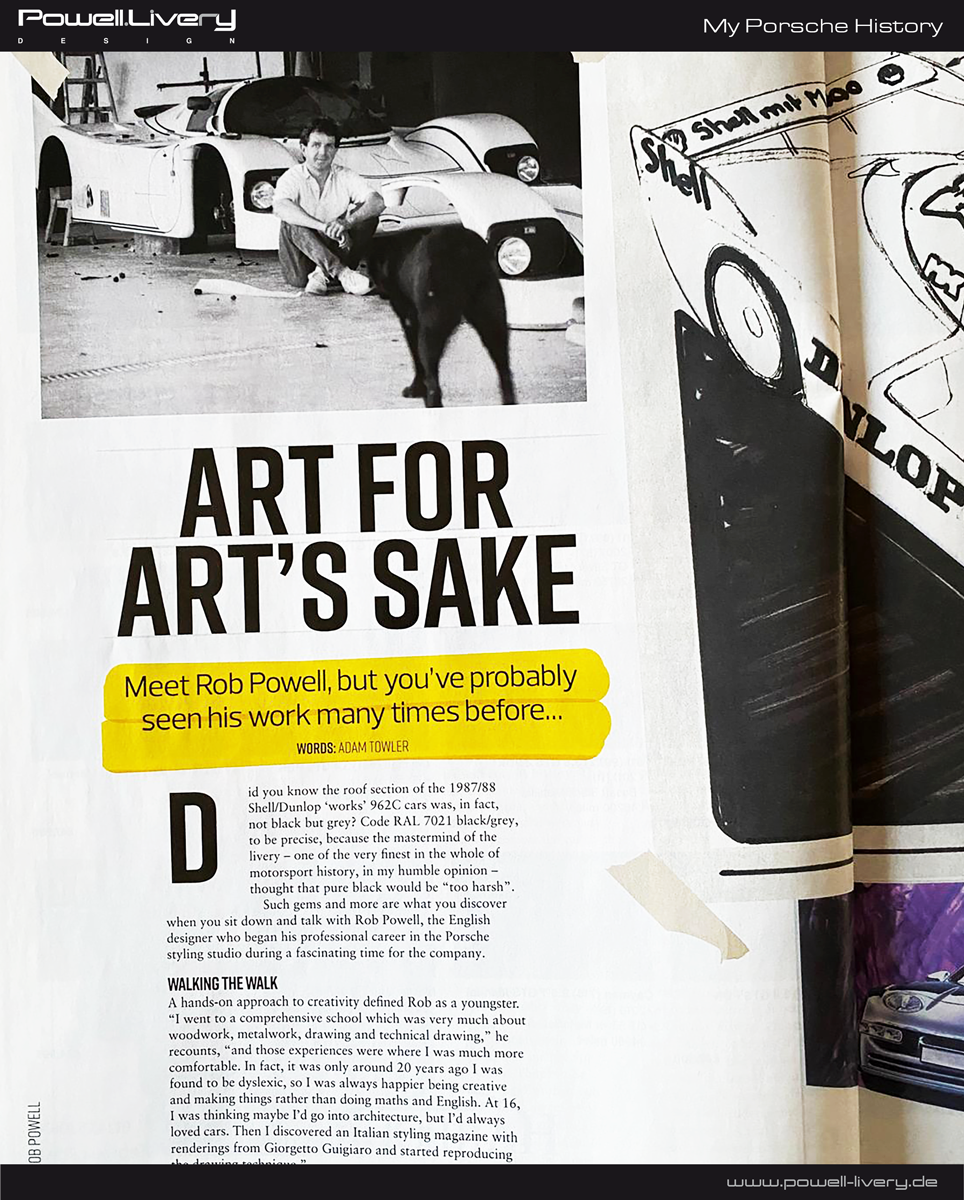
Porsche Club UK magazine. Many thanks thanks to ©adamtowler writing for the @porscheclubuk July magazine for these pages looking back at my career as a designer at Porsche in the 80's. It's an honour!. Very much a time one would like to relive but at least I was part of the legacy.
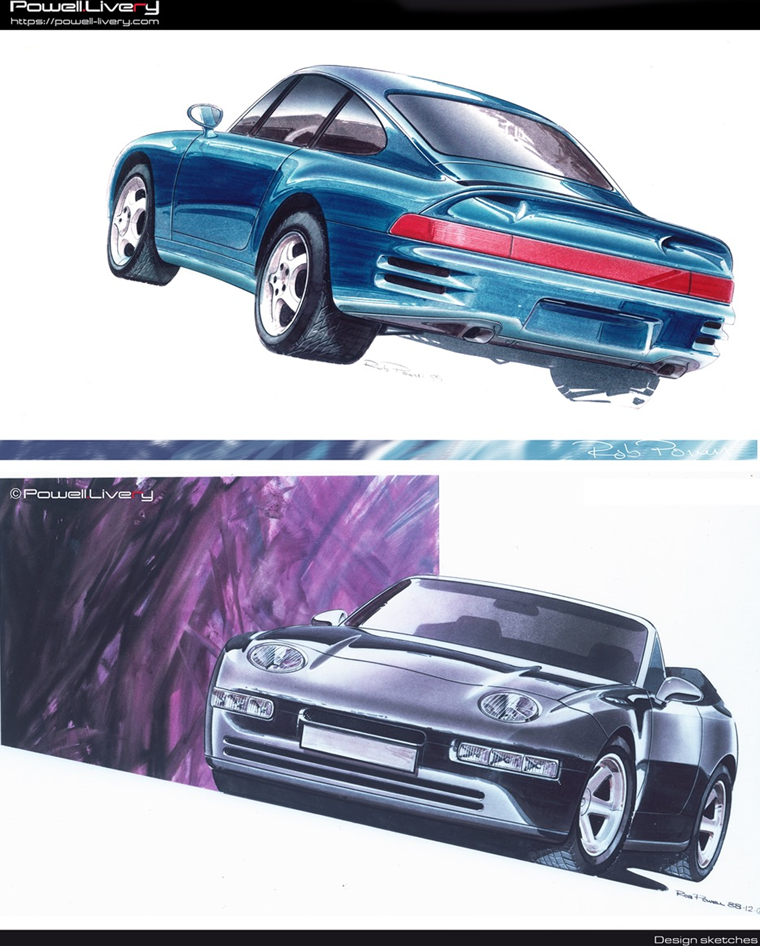
Porsche Design sketches / proposals 1988/89. Porsche 965 V8 ( concept) and 968 Cabriolet
Being a car designer in the 80's had one big difference to today. Designs where drawn by hand. Such sketches were drawn on Vellum paper. This was partly transparent, very much like backing paper. After drawing the design with pencil the colour phase began. Marker was used, sometimes on the back of the rendering as well, to create the main blocks of colour and reflections.Pastels - one scraped pastel dust on to a separate piece of paper - for the areas that faded. This was applied by using a soft cotton pad, which was dipped into the dust, then rubbed carefully onto the areas required. Wheel areas usually went in towards the end.
Coloured pencils used for fine lines. White highlights applied with a brush using Gouache paint.
To finish, the rendering was then often cut out and using spray glue, stuck to clean white board for presentation.
Quite a process !
Top: a design proposal for the planned Porsche 981 V8 car based on a simple briefing, to incorporate design elements from the 959.
Lower: The 968 Cabriolet, possibly a facelift sketch, one of many.
The Link on Youtube shows this 965 V8 Project from a Porsche Museum film: https://www.youtube.com/watch?v=2P6gTpG0Dj
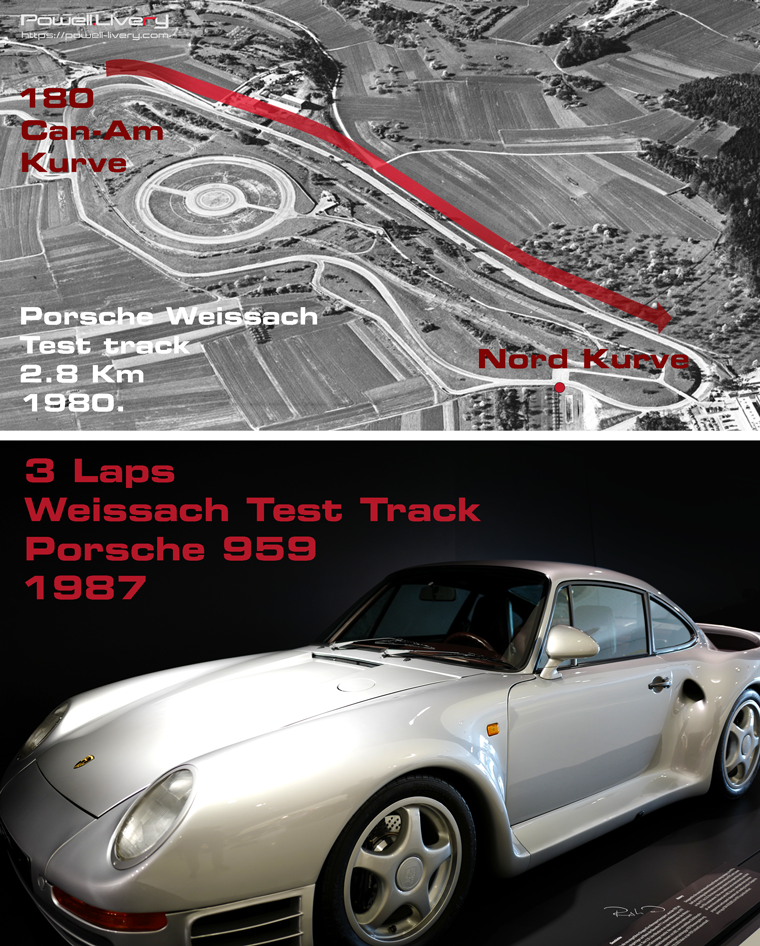
3 laps in a 959 with Porsche works test driver Günter Steckkönig.
In the mid-80s I was sitting in the design studio when the phone rang.
It was Günter — ex-racing driver, including Le Mans ’83 in the 930, and one of Porsche’s test drivers — speaking in his usual polite, understated way.
We’d got to know each other through projects at Weissach and at Bern Stahl’s paint shop. He was humble, in the most positive way and loved Porsche. One day he had asked me to design the livery for the Trigema 928 he was involved with — during a long drive from Weissach across the Schwäbische Alb to Trigema he told stories of racing and development driving. He wasn’t a show-off; he was precise, disciplined, and unbelievably competent. After that project, Günter would call occasionally to say he was heading onto the test track to evaluate various cars and components. ( once, while driving a 928 myself, I nearly jumped out of my skin when a 956 suddenly filled my mirrors and swept past before I had time to react) Günter had been involved in the 959 development program and knew them inside out.
“Rob… I have Dr. Bott’s 959 here. Want to join me on the track?”
A pause — then a joking question: “Have you had lunch?”
Thirty minutes later we rolled onto the 2.8 km Can-Am track. ( Red spot) I’d worked on the 959 interior and colour & trim, but never experienced it in motion. The first 2 laps were fast but respectful. The third… was something else.
Exiting Can-Am-Kurve the 959 exploding down the straight. The next 180, Nordkurve, rushed toward us. My right foot instinctively pressed into the floor — as if it could help us stop. At the very last moment he braked, turned in, and placed the 959 into a perfectly controlled four-wheel drift so sideways I had to look out of his window to see where we were going.
Moments later we rolled off the track and looked at each other, both smiling.
GET A FREE CONSULTATION ON YOUR PROJECT
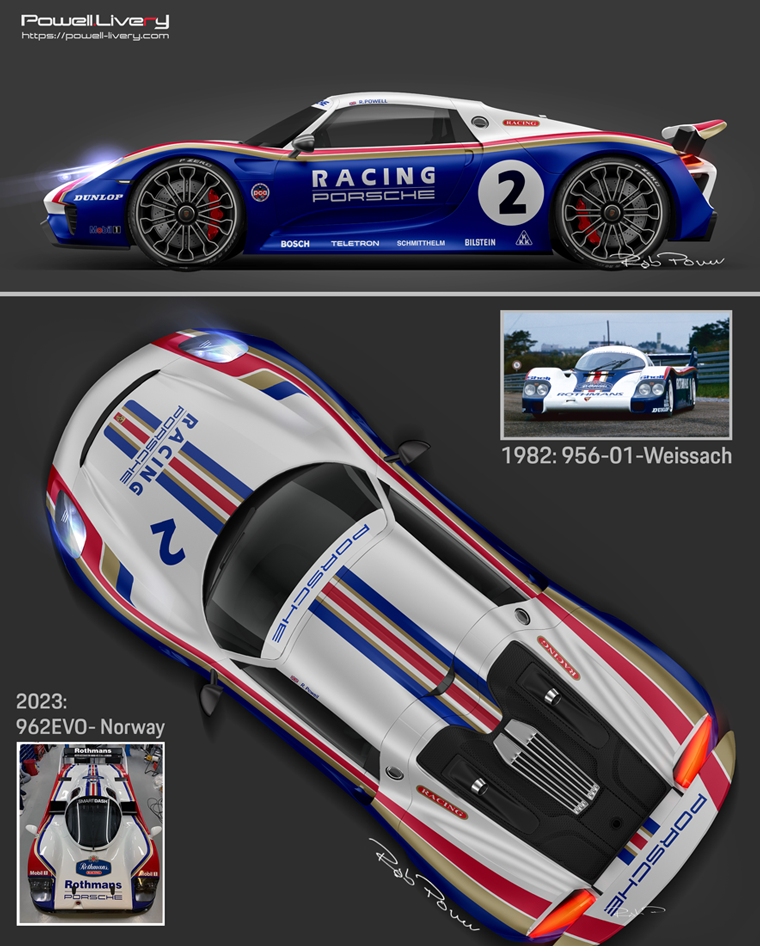
Porsche 918 in Those Iconic Colours
In the 1980’s we first applied these now-iconic colours to the Porsche 956. What followed is, quite simply, history.
Very few liveries have been referenced, replicated, and re-imagined as often as this one. It has appeared—copied, adapted, and celebrated—on almost every generation of Porsche since.
Personally, I have always favoured our 1982 livery, where the colours sweep dynamically around the cockpit. The 1983 version, with its simpler centre stripe, proved easier and less time-consuming to apply, but the earlier design remains my personal benchmark.
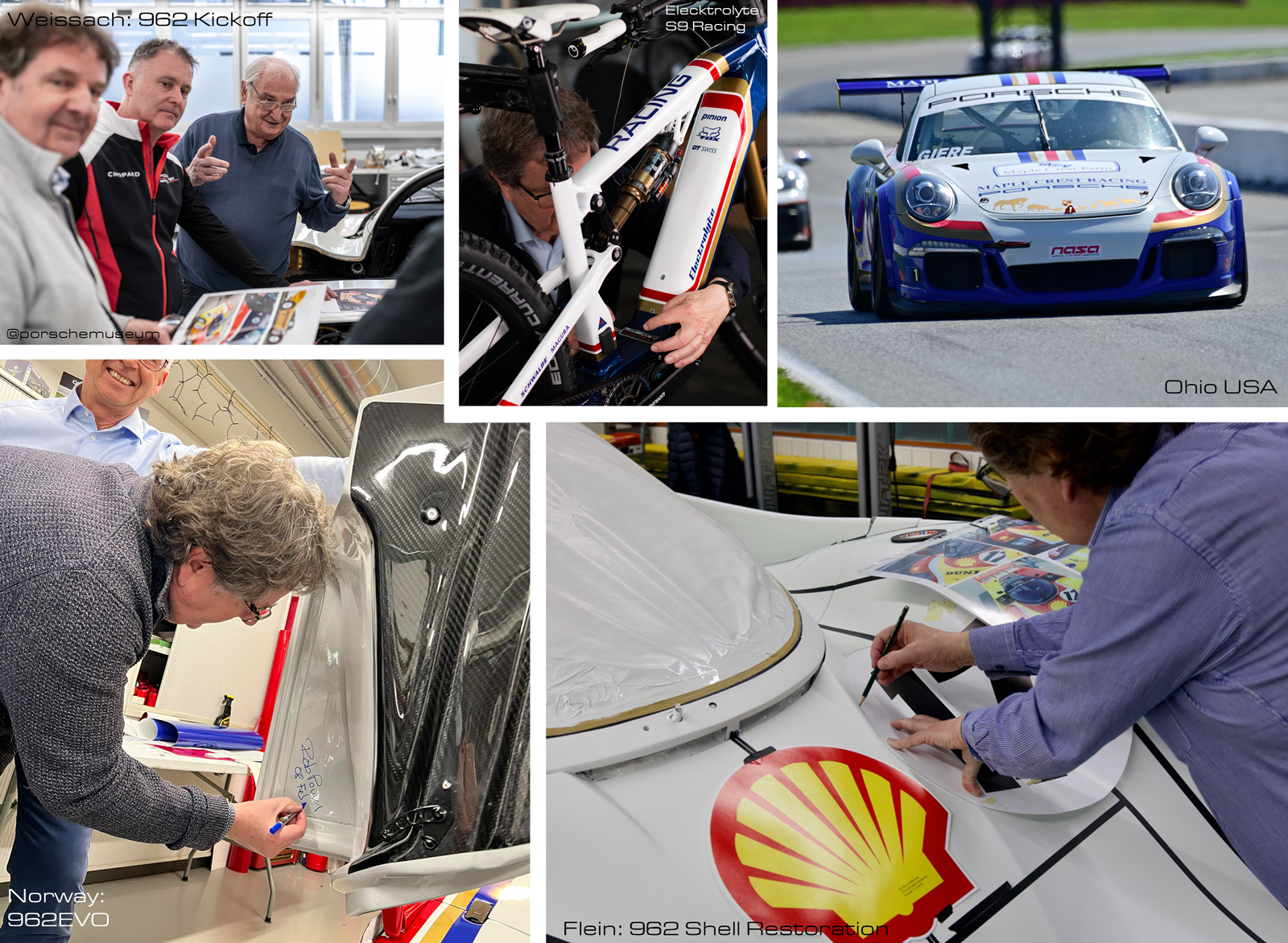
In 2024, I was invited to Norway to apply a revised interpretation of this livery to the stunning 962 EVO. For this version, I introduced additional graphic elements across the upper surfaces, allowing the colours to wrap more fully around the cockpit. The car is owned by V. Frognar, with the project engineered by M. Sivertsen, and it was a privilege to see the concept evolve on such an exceptional machine.
This concept livery for the Carrera GT draws inspiration from both historic versions. The sides remain unmistakably blue—there was never any question about that—but the design advances further when viewed from above. Sweeping stripes accentuate the car’s remarkable forms, enhancing the sculptural lines created by my former colleague, Tony Hatter.
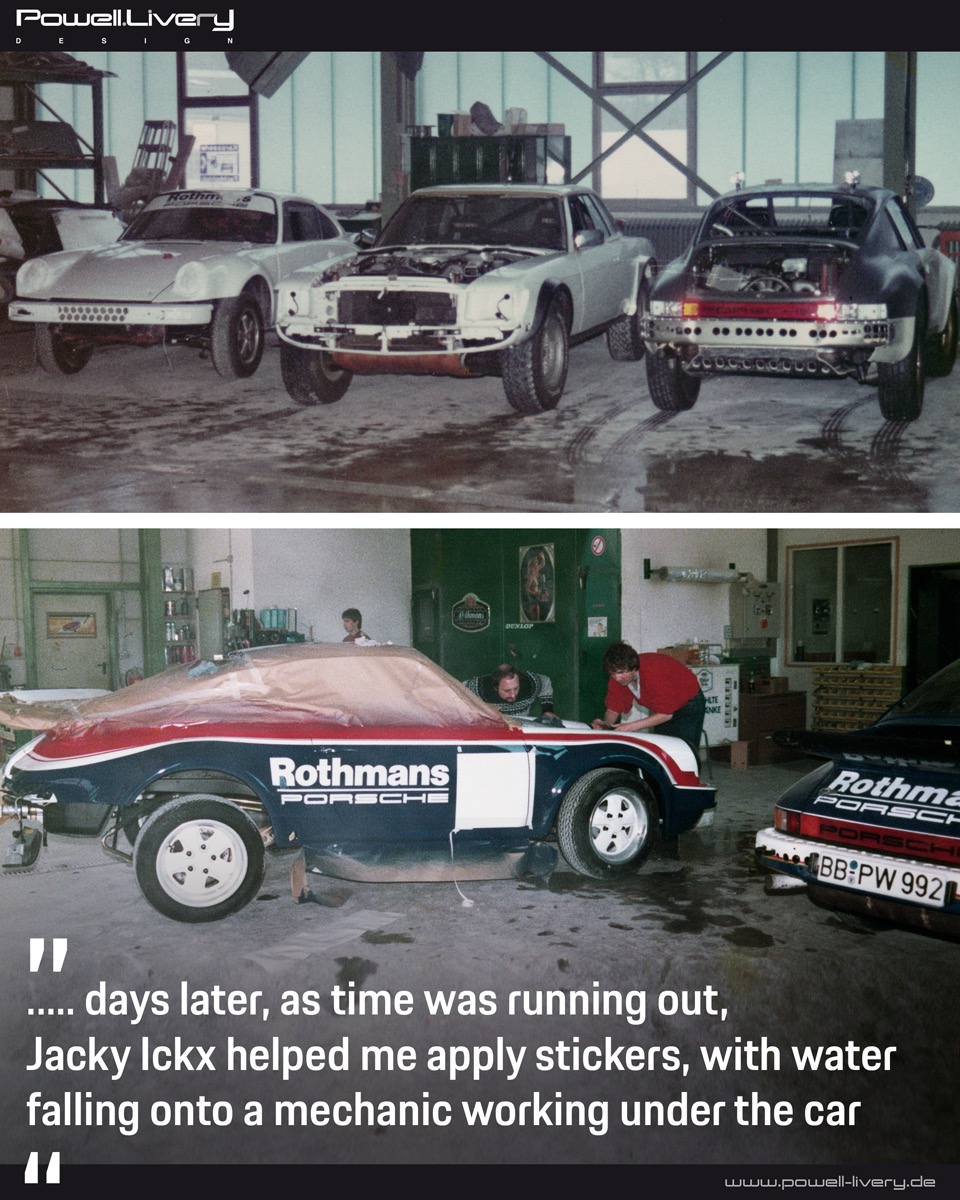
Porsche 911 Paris Dakar
1983. 'Stahls' Paint shop in the village of Mönsheim.
This is late December 1982 and the finishing touches are being made to 2 of the Paris Dakar Cars. I am in the red sweater, next to me is Gerry, the marketing guy, from Rothmans.
A day or so later, I was in the Porsche workshops, ( a lot cleaner than the paint shop) where all 3 cars were being finished. The third car had just been delivered and I was trying hard to apply the stickers amongst all the action. Time was running out for me and I wanted to get the long Rothmans / Porsche on to the door. Jacky was sitting on a work bench and saw me struggling and came across to offer me help. So with a mechanic working under the car we managed to get it on, with water dripping all over the guy. 🙂
Top picture: A few days earlier. In the middle is the MB which also took part in the Rally.
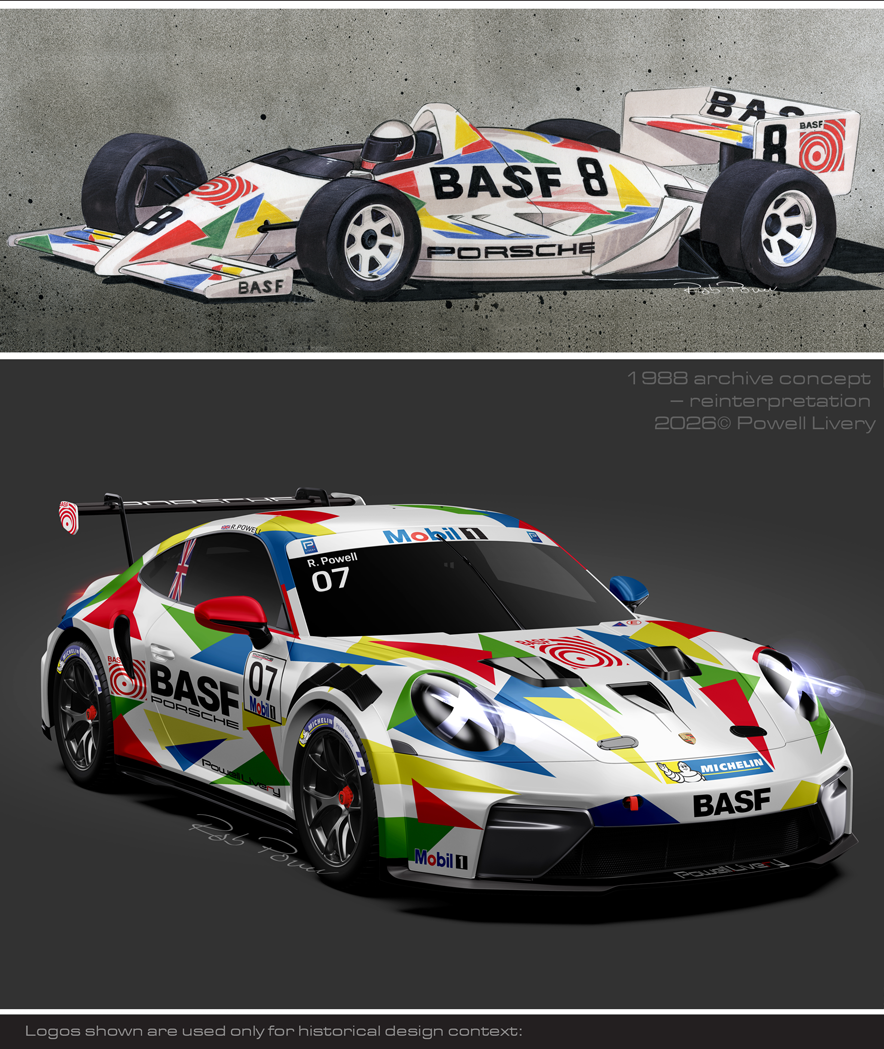
Porsche 2708. 1988 - Porsche 911 GT3 Cup. 2026
In 1988 I created several livery proposals for Porsche’s Indy car, exploring potential sponsor collaborations. The original artwork shown here was hand-drawn using marker, pencil and pastels on cotton vellum paper, with the background completed using airbrush techniques.
I always liked this particular concept, so I revisited the idea and created a new interpretation for a 2026 GT3 Cup car.
The geometric design approach allows many variations in shape and colour. Teams with strong colour identities could easily adapt the concept to create a distinctive and recognisable design direction.
Powell Livery offers bespoke motorsport livery design worldwide — from race cars and historic restorations to unique graphics for road cars. If you would like to discuss a project, please feel free to get in touch.
*BASF is not a sponsor of Porsche. If any rights holder has concerns regarding the use of referenced brand imagery within this historical design context, please contact Powell Livery and the post will be reviewed or removed.
Logos shown are used only for historical context and serve as placeholders for potential sponsor branding.
GET A FREE CONSULTATION ON YOUR PROJECT
Disclaimer
Powell Livery is an independent design studio and is not affiliated with Dr. Ing. h.c. F. Porsche AG or BMW AG. All trademarks remain the property of their respective owners.
Inpressum Datenschutz Disclaimer